1922 University Avenue. Madison WI. 53726

............

Sunday, August 22, 2010

CALL FOR WORK: National Juried Exhibition at the Steenbock Gallery

February 28 - April 8, 2011

sponsored by 

The Center for Photography at Madison.

Entry Deadline: November 15, 2010

The Center for Photography at Madison is pleased to issue the call for our first juried national exhibition at the Steenbock Gallery.  As Madison's primary photographic arts organization, we are pleased to partner with Andy Adams of FlakPhoto.com in presenting an exhibition of contemporary photography that will offer chosen photographers an opportunity to exhibit in Madison’s first gallery exclusively dedicated to the photographic arts.  Specifically designed to allow participation by all working photographers this exhibit will provide a dialogue between emerging photographers, students, professionals, educators and artists in Madison and across the country. In addition to cash prizes, the winning photographer will be awarded a future solo exhibition at the Steenbock Gallery.

Juror: Andy Adams of Flak Photo

Andy Adams is the Editor/Publisher of FlakPhoto.com, a contemporary photography website that celebrates the culture of image-making by promoting the discovery of artists from around the world.  An online art space and photography publication, the site provides opportunities for a global community of artists and photo organizations to share new series work, book projects, and gallery exhibitions with a web-based photography audience.
Recent features include 3030 Press' New Photography In China, Humble Arts Foundation's 31 Under 31: Young Women in Art Photography, Hamburger Eyes Photo Magazine's Inside Burgerworld, the Photographic Resource Center’s EXPOSURE: The Annual PRC Juried Exhibition, Big City Press' Hijacked, Volume One: Australia andAmerica, Center's Review Santa Fe 2009, David Wright + Ethan Jones' Pause To Begin, the Center for Fine Art Photography's 2009 International Exhibition, Blurb’s Photography Book Now, and the Magenta Foundation's Flash Forward: Emerging Photographers 2009.

Calendar

Nov. 15, 2010 Entry deadline
Dec. 1, 2010 Review of works
Jan. 7, 2011 Photographers notified
Feb. 24, 2011 All work delivered to gallery
Feb. 28-April 8, 2011       Exhibition Dates
March 4, 2011(6-9pm) Opening reception
April 9, 2011 Pick up of unsold work
April 11, 2011 Shipping pick up*
*Photographer schedules pick up of work with preferred shipper.

PRIZES AND SPONSORS

FIRST PRIZE
$500 cash prize and a solo exhibition at the Steenbock Gallery in 2012.
SECOND PRIZE
$250 cash prize
THIRD PRIZE
$100 cash prize
*Honorable mentions may be awarded at juror's discretion.

All accepted works must be at the Steenbock Gallery (hand delivery or shipped) by 4:30pm on February 24. Any pieces not received by this time will not be exhibited.
All unsold works must be picked up by 12noon on April 9. All unsold works must be picked up by shippers by 4:30pm on April 11. Artists are responsible for paying and arranging their own shipping.
Any additional, detailed shipping instructions will be sent later following notification of acceptance
Upon notification of acceptance, Artist agrees to:
•provide artwork that is ready to be hung:
2D work must be prepared with hanging wire.
3D work must sit sturdily on pedestal or floor.
*arrange pick-up of unsold artwork on either April 9 (for artist or buyer pick-ups) or April 11 (by artist designated shipping company.)
SIZE AND WEIGHT No work may exceed 5 ft. in any direction or be over 50 pounds in weight.
SALES: A 30% commission will be retained by the gallery on all sold works. Work remains the property of the artist until sold.  Sold artwork shall remain in the exhibition until the close of the show. 
INSURANCE: Artists should self-insure work during transit and while on exhibit.
INVITATION AND WEBSITE One image will be chosen for the invitation cover design. Images of accepted works and profiles of selected artists will be featured at http://www.steenbockcpm.blogspot.com.

ENTRY CHECKLIST

[   ] CD: Up to 5 works submitted on CD. One jpeg per work, titled as name_number.jpg. Must be numbered to correspond with numbers on entry form. Jpegs should be 1000 pixels (minimum) In longest dimension, and at 300 dpi.
[   ] Entry form: Filled out completely and typed or printed clearly. Detach and return with CD and fee
[   ] Entry fee: Non-refundable fee of $25 payable by check, money order or cashier's check. Make payable to The Center for Photography at Madison, include Steenbock Juried Show in memo line.
[   ] SASE: Include a self-addressed stamped envelope for the return of non-accepted material. CDs will not be returned without it.
Please do not include any additional or unrequested material.
AGREEMENT Signature gives artist's consent to all conditions specified in this prospectus. Submission of your entry grants CPM permission to use your artwork or reproduction of likeness in promotional materials for this exhibition.
Signature: ____________________________

Please send form to:

The Center for Photography at Madison
attn: 2011 Steenbock Juried Exhibition
303 South Paterson Street, Suite 2E
Madison Wl 53703

The Steenbock Gallery in the Wisconsin Academy of Sciences Arts & Letters.
1922 University Avenue
Madison Wl 53726
The Steenbock Gallery, sponsored and managed by the Center for Photography at Madison in partnership with the Wisconsin Academy of Sciences, Arts and Letters, is dedicated to the exhibition, exploration and appreciation of the photographic arts. The Steenbock Gallery provides opportunities for photographers and curators, and serves as a forum for dialogue between artists educators, students and the public at large.

ABOUT CPM and THE WISCONSIN ACADEMY

In 2008 The Center for Photography at Madison (CPM) partnered with the Wisconsin Academy for exhibit space. CPM is a 501 (c)(3) non-profit organization founded in 1998, and offers a broad range of educational programs, exhibitions, facilities and publications. CPM offers classes, exhibit opportunities, and a wide variety of programs at its Paterson Street location.
The Wisconsin Academy of Sciences, Arts and Letters is a non-profit organization whose goal Is to connect people and ideas from all areas of knowledge and all walks of life to celebrate thought, culture and nature in our state. The Steenbock is one of two galleries affiliated with the Academy, the other being the James Watrous Gallery.
Administration of the Steenbock Gallery makes CPM relevant and accessible to a wider audience including University of Wisconsin faculty and students. These mutually beneficial liaisons provide exhibition, curatorial, and administrative opportunities, and help make it Madison's first photo gallery devoted to the history, contemporary trends, and future expansion of photographic media and theory. Located in the Wisconsin Academy building, the Steenbock Is readily accessible to the UW campus and affiliated organizations, and the greater Madison area.
GALLERY HOURS: Monday-Friday 8:30am-4:30pm
CONTACT fNFORMATION
Phone(CPM): 608.287.1182
 (gallery): 608 263 1692
email steenbockcpm@gmail.com
blog http://www.steenbockcpm.blogspot.org
websites www.cpmad.org and www.wisconsinacademy.org

Thursday, July 8, 2010

After the Reign

Interview by Madison Magazine associate editor Katie Vaughn, posted at Madison Magazine's blog on July 8 2010. When one thinks of a beauty queen, specific images come to mind: glittery gowns, coiffed hair, poise and a sparkling crown. Growing up in Louisiana, Jessie Eisner-Kleyle witnessed these and other mainstays of pageant life.But hearing a story about a queen who both embodied and defied these norms—a girl who not only wore a crown but was also a champion skinner of nutria, a large, semi-aquatic rodent—piqued the photographer’s interest in the women who participate in pageants.

Armed with her camera and an interest in gender roles, Eisner-Kleyle set out to photograph former beauty queens to explore their post-reign lives and the other, perhaps less obvious, ways they express femininity.
The series of photographs became Nutria Queens, an exhibition that’s on display through July 30 at the Steenbock Gallery. Recently, Eisner-Kleyle took some time to explain how the project came about—and what’s it’s meant to her.

How did you get the idea for Nutria Queens?
The Lake Charles American Press published an article in 1996 about a girl who was queen of the Cameron Fur and Wildlife Festival and was also a nutria skinner from a long line of skinners. Right after the parade she was in the skinning contest, and they wrote in the article about how she had to run and change out of her gown into her jeans to make it from the parade to the contest. The men in her family were the skinners, and were so proud of her, and so impressed with her talent. During my graduate studies in Wisconsin, and in my own research into gender and society, I found myself thinking more and more about that woman—wondering what she was doing these days and how she’d balanced such an extreme feminine activity as pageantry with something so decidedly un-feminine as nutria skinning. We see portraits of these queens in the paper when they’re crowned, in festival histories and Mardi Gras museums, and it’s always the same shot—a sparkly gown, huge crown, scepter and satin sash. I became more and more interested in the reality of these women.


What interested you in these former pageant contestants?
Every woman in this series, with the exception of the original queen from the article, was brought to me through friends and family; in fact, some of them are friends and family. The project had been in me for so long that when I started moving forward on it I sent emails to friends and family back home telling them what I was wanting to do and asking if they knew any former queens. I wanted to test the waters and see if there was anything there. As it turns out, everyone knows a queen! My mom worked with several queens, and my husband’s parents were part of a Mardi Gras Krewe and opened up their directory and mailed letters about my project to every queen they knew. One of my bridesmaids had worked with one of the queens at The Gap years before, and still knew how to get in touch with her and passed it on. My sister in-law’s twin is one of the queens, and her daughter is another.
Every queen that participated heard about the project secondhand and contacted me with her interest. The only queen I actively pursued was the queen from the 1996 article. I would have moved ahead with the series without her, but I don’t know how happy I would have been about it. Luckily I didn’t have to find out!


What was it like photographing these women? 
In every way this phrase can be turned, it felt like going home. Of course, I got to stay with my family and use my dad’s truck to drive around and meet these queens for sessions. But to walk in to the home of a complete stranger and be welcomed, entertained, sometimes fed (though ALWAYS hugged) is something that I’ve never found outside of southwest Louisiana, and something that I miss. That sense of welcoming familiarity was all encompassing, even in the women who had sort of missed the fact that I was originally from there and would introduce me as “the lady from Wisconsin.”
These were talkative and easygoing photo sessions. Some women met me after work and school with just their kids around, and others had houses full of family and friends curious about the project and about me. Some would sit with me for quite some time, showing me scrapbooks, driving me around their town and talking about their time as queen, before we started. Others would give me a tour of their home and we’d start shooting right away while we talked. Some made a day of it, and those shoots included airboat rides, alligator hatching, driving out to oil rigs or visiting with neighbors at the dock to see what they’d caught that day; I would shoot the entire time. I pushed each sitter to design her own session and allow me to follow behind, documenting what she would have been doing anyway, and I think that’s a big part of making each sitter comfortable and each portrait something more than those sterile queen portraits I’d seen my entire life.


What surprised you most about meeting the pageant queens and seeing what their lives were like?
I guess there’s a fine line between being surprised by something for the first time, and being reminded of something you’ve always known.
How easy these women were in front of a camera, talking to a total stranger about their life and their work, their history and their plans for the future was a constant shock, though that may be something I’ve forgotten by being out of the South. While some were decked out and completely made up for the camera, others wore jeans and T-shirts and just rolled with it. That casual attitude surprised me, especially coming from women who were, essentially, in this project based on their ability to plan and prep.
The funniest thing was that when I picked up a camera, regardless of if she’d reigned one or twenty years before, these women still knew how to turn it on for a camera. It was a constant struggle to get them to ignore me!


Did being involved in pageants still have an impact on the women?
There were some who knew each other, not personally, but from being in the pageant world. Several were curious about the other queens and wanted to know what I did for the shoots with other subjects. Sometimes they were a little critical about what I’d done with other queens; is that quickness to rate and judge left over from pageants? I don’t know.
One woman, when she spoke to me about her time as queen, consistently said “bride” instead of “queen.” She’d gotten married decades before in a suit at City Hall, so her dress for the Krewe was the most formal dress she’d ever owned and was, in fact, a redesigned and dyed wedding dress. Her portrait from her 1980s crowning still hung above the mantel in her living room, so I’d say she was impacted daily by her time as queen. Keep in mind, though, that for each queen who kept her regalia at arm’s length, there was another who had delivered 10,000 babies in her career, had a hospital wing named after her and couldn’t have cared less about her time as queen.
The one trait that each queen shared with the next was her gracious manner, her ability to talk about her life and open herself up to a stranger and, like I mentioned earlier, to be completely at ease in front of a camera, or at least look like she was. I have to think that grace under pressure is a great side effect of pageant life.


How significant is it that these women are from Louisiana? In what ways does the setting shape this project?
In the trajectory that the project has taken, it’s vital. This project would never have been seeded had I not read that article. Louisiana is a strange and fascinating place, and the rules that govern our behavior are bizarre, so without that upbringing would I have been so attuned to the oddities of societal norms once I left? Seven years after leaving, I still qualify some of my behaviors by telling a story about how we do it down home.
Once the project was going, would I have found a population so quick to spread the project by word of mouth, so eager to let me back in, and so proud of their lives that they could stand unflinchingly in front of a camera and tell that story? I can’t say no definitely, but I doubt it. My Midwestern portrait projects often found me trying to calm wary and anxious women who were suspicious of what I was doing with these portraits, and I encourage that—I would never let a stranger photograph my children or me without subjecting them to extensive interviews and background checks!! But every one of these queens opened their doors to me and shrugged me off as I told them about my release forms. They trusted me from the get go and that encouraged the project every step of the way.
Every background tells a story. The coastal landscape is identifiable to anyone who’s ever walked a shoreline made of broken concrete. The sky during that rainy week was perfect, not only for lighting photographs but for setting a scene, and the color of grass or water or sky in Louisiana is a huge part of what visually defines that place. That color and density is something that I’ve missed in my years in the Midwestern prairie. Even the interior shots tell stories, and every woman gave me a tour of her new rooms that had been rebuilt after [Hurricane] Rita.
How did your interest in fairy tales come into play in working on this series of photographs?  My interest in fairy tales came from the stories I was told in Louisiana. That eventually formed my interest in gender roles as taught through childhood literature. While I didn’t start this series to be based equally on portraits and interviews, like I have in some of my other portrait series, I definitely interviewed these women during the process. Our fairy tales were passed down orally by women who knew that those stories would teach values to the next generations and were eventually collected and written down by men who knew that their culture would be fortified by these tales. Those stories of the people were entrusted with the continuation of a culture. When you have to rebuild so often, your stories and your culture become your home, and the place you can return to. When your heirlooms are carried away by wind, you replace those objects with stories. When the home you grew up in washes away, you hold your history tighter. As we all migrate from home and start our own families, we find ourselves grounded and refreshed by our personal mythologies. The culture of Louisiana is rooted in migration, rebuilding and finding home wherever you can. I’ve learned that in this series, the viewer appreciates the imagery, but WANTS the stories. Though I didn’t at the time of the shoots, I absolutely see a correlation between reinforcing the values of your past while protecting your future in the stories you pass down, and I see it in both current day Louisiana and seventeenth-century Germany.
What questions do you hope this exhibition raises in viewers’ minds? What do you hope they get from seeing your work?
Of course, I want there to be a constant concern for the Gulf Coast and its residents as we become increasingly careless with our planet. I want you to look at these images, at the people that thrive there and connect your own life with those in Louisiana. Then write to your politicians, and protect what’s precious.
But this wasn’t intended to be a public service announcement, nor was it intended to raise pity for the people of my home. This work was made in celebration, not of the beauty of these women or of how lovely they look in an evening gown, but of their strength, and of how smart and resilient they are. Every single one of them is an expert at something that may surprise you. Each of these women is, yes, a former beauty queen, but that was one year of her life. Every day in and outside of that year she is a mother, a daughter, a sister, a doctor, a teacher, an advocate, a rodeo champion, a builder, a hunter, an entrepreneur and, of course, an extremely fast nutria skinner. Her time as queen was a major life event, but it didn’t define her life.
I want people, from seeing any of my work, to question the way society has taught them to react to gender. Is there something you do just because it’s expected of your gender? Some way that you behave? Some value you place on yourself based on nothing more than your gender? What about in how you look at the people around you?
Coincidentally, one of the queens moved to France last week. She had emailed, during a prior visit, that she loved France because she didn’t have to wear makeup every day. I reminded her that there was no American law that required a woman to wear makeup and she should absolutely do what made her happy, especially with her face! We’re limited by ourselves and by what we think we’re supposed to do, but I do think we’d be a lot happier if we more often did what felt right, and not always what society and our gender tell us we have to.
Nutria Queens runs through July 30 at Steenbock Gallery, 1922 University Ave.  For more information, visit wisconsinacademy.org.

Photos courtesy of Jessie Eisner-Kleyle. 

Katie Vaughn
An associate editor at Madison Magazine, I'm also an unabashed arts enthusiast. Paintings, plays, music, movies—I'm intrigued by all forms of creative expression. I enjoy talking with artists and sharing their insights, challenges and inspirations.

Monday, July 5, 2010

CALL FOR 2011 EXHIBITION PROPOSALS Deadline: August 1


Are you ready for your solo exhibition at the Steenbock? 

Have you curated a photographic exhibition that the world needs to see? 

Then we have your application...


Our exhibit guidelines, a map of the gallery, and the application form are all available below 

and here, 


as jpegs that you can download and print. 

Need help, not on Facebook, or just prefer a pdf emailed to you? 

We can't wait to see your work...


Tuesday, June 29, 2010

NUTRIA QUEENS Review by William Zuback

Jessie Eisner-Kleyle is a Madison based fine art photographer and educator who's current exhibit Nutria Queens is showing at the Steenbock Gallery in Madison until July 30th. Jessie began her journey back home to Louisiana to photograph these past pageant queens in the summer of 2008. She was first drawn to this subject matter as a series when she recalled reading an article about a Nutria Skinner Champion who was also the Fur and Wildlife Queen in Louisiana when Jessie was growing up. Remembering this article Jessie wondered what this woman and other official pageant queens like her were doing today? The subject matter also raised other questions for Jessie as she describes it in her artist statement on her website; “This project explores the off stage lives of former queens and the particular regional femininity in which I was raised.” Jessie was able to locate and connect with the Nutria skinner champion and many other past queens from a variety of pageant titles. Her exhibit captures these women in their current surroundings.

First of all you may be asking yourself what the heck is a Nutria? Embarrassingly the only reason I know what a Nutria is comes from watching the program Billy the Exterminator on A/E. A Nutria is a large rodent/beaver like animal that lives in and around water in the southern states. The article that sparked this series was of interest to Jessie because she was curious how this woman, “balanced such an extreme feminine activity as pageantry with something so decidedly un-feminine as Nutria skinning.” The exhibition consists of 26 photographs of eleven different queens in a variety of sizes from 13”x8.65” to 22”x32”. The exhibit has a nice flow to it with photographs that candidly capture the past beauty queens in their environments as well as portraits that appear to be more organized and posed. The collection of photographs are displayed in a way that fills the intimate space of the Steenbock Gallery with a visual rhythm moving in and out of the selective larger images and the more numerous smaller photographs.

What you find as you follow these woman through the selected captures Jessie has chosen to display are eleven women who live pretty ordinary lives like the rest of us. A few of the queens show their old flair by how they posed for the camera but the majority seem to have left their pageantry days behind them and although they still retain all of or signs of their past beauty days they seem more interested in raising a family or having a career. What I like about this series is that the photographs allow the viewer a glimpse into the current lives of these past queens. I see this series having some similarities to the Wounded in America series by Robert Drea and Stephanie Arena which shows portraits of gun violence survivors but offers a deeper look into their psyche by offering a brief written narrative of each survivor. Dawoud Bey comes to mind as well with his portraits of high school kids and the added dimension that the narratives written by each student photographed offers the viewer. Not that an artist should provide a photographic narrative or series in a nicely wrapped package for the viewer to digest but with the stereotypes of pageants and the complex lives of individuals I do yearn for a little more information than the photo's create.

Jessie has captured the confidence, strength, compassion and independence of these beauty queens. I can only imagine that participating in such an event once in a life time or numerous times is not for the timid. The portrait of Adrienne sitting on the back of a Jeep with a gator by her side is a beautiful color portrait of a queen that is still close to nature. Her long blonde hair blowing in the wind along with her confident smile displays some of the beauty the judges probably recognized many years ago when they crowned her Louisiana Fur and Wildlife Festival Queen. For what it's worth as a male I can't help but notice she isn't wearing a wedding ring? What is her life story?  

This is my favorite of Jessie's portraits. Kate, 1990 Water Festival Queen. This is not a posed photograph. It's so perfect it looks staged. The one son standing in the sink gazing at the camera. The younger son holding onto his sisters toe while dad is carrying the daughter piggyback. Kate stands both proud and in seemingly control of a chaotic and somewhat surreal environment. You have to wonder if the frantic pace and experience of being on and in control of your emotions and actions in a pageant setting didn't help prepare her for moments like these.

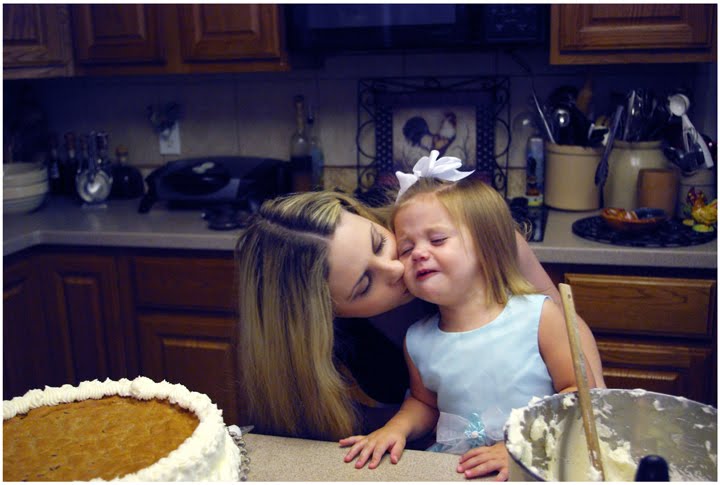
Bronwyn, 2000 Patterson Cypress Sawmill Festival Queen caringly comforts her daughter. You don't know what has upset her young daughter but you do wonder if this is only one of many times mom will use her pageantry experience to console the hurt feelings of her daughter if she too becomes a contestant and possible future queen?

Nissa, 1991 Job's Daughters Miss Congeniality. This photograph and the other one in the show of Nissa makes me laugh. In this photograph Nissa appears to be anything but congenial. Is she bored with her current life? Was winning Miss Congeniality the highlight of her life so far?

These photographs and many more of the twenty six images in this exhibit invite you into the world and a little bit the minds of these former queens. Jessie has done a marvelous job capturing the strength of these women. You can see this exhibit through July 30, Monday through Friday 8:30am – 4:30pm at the Steenbock Gallery in Madison, Wisconsin.

original post from Milwaukee photographer William Zuback's blog, June 29 2010


Wednesday, June 16, 2010

HOW CAN MADISON BECOME A STRONGER CENTER FOR INNOVATION?


That's the question being explored in the City of Madison's first cultural planning process. Explore the Madison Cultural plan website to learn what the plan is all about, which creative efforts are included in the idea of culture at the heart of the plan, when and where planning activities will take place, why the the plan is important to Madison's residents, businesses and visitors, and how any resident can get involved.

WHAT IS A CULTURAL ARTS PLAN?

A cultural plan is a community decision-making process that seeks ways to better support and utilize creative work. Cultural plans explore resident’s preferences, the adequacy of public and private structures that support creativity and innovation, and identify specific action steps that can make the community’s creative portfolio stronger, more accessible, more sustainable and more diverse.
WHOSE CREATIVE WORK IS INCLUDED IN MADISON’S CULTURAL PLAN?
The Madison Cultural Plan will explore the arts, history, and the sciences and will include exploration of the work of individual artists and creative workers as well as institutions in both the commercial and nonprofit sectors. The plan intentionally defines culture broadly. It includes, for example, individuals and organizations who are students, amateurs, and professionals working in such varied fields as artisan food production; digital production; architecture; history and heritage; traditional, experimental; and fine arts; scientific research; software and hardware development; advertising; publishing; gardening; entertainment, environmental programming; and so forth. If creative content drives the work an individual or organization does, it is included in this plan.
WHY IS THE CULTURAL PLAN IMPORTANT TO MADISON?
Creativity and innovation have long been major drivers of Madison’s unique character and its economic base. They are woven into our sense of place. Just as it is important to plan the ways in which the city supports neighborhoods, it is important to plan the ways in which it’s policies and resources support creativity and innovation.
  • What is Madison’s vision for its arts and cultural future?
  • What arts and cultural opportunities do residents want for themselves and for their children?
  • How can broad access to opportunities in creative play, learning, and work be promoted?
  • Are we making the best use of our public and private facilities?
  • What structures and resources are necessary to strengthen and sustain our creative community?

The planning process will include research; GIS mapping; surveying; conducting interviews, focus groups, roundtables, and public hearings; and working with a local Steering Committee in the formulation of recommendations for action.

GETTING INVOLVED
Learn more about how you can get involved. Your voice is important. There are opportunities to complete surveys, participate in public meetings, and even conduct your own discussion groups with peers, friends, or co-workers. The strength of the plan relies on the willingness of residents, artists and creative workers, and creative institutions, commercial and nonprofit, to participate. Check the Get Involved page; it’s fun!

WHO IS CONDUCTING THE CULTURAL PLANNING PROCESS?

The City of Madison has retained Mary Berryman Agard & Associates and partners Vandewalle &  Associates, and Robert Bush to conduct the cultural plan.
 The City of Madison staff person leading this effort is
 Karin Wolf, Arts Program Administrator
Madison Arts Commission
Department of Planning, Community & Economic Development
Madison Municipal Building
215 Martin Luther King Jr. Blvd.
Madison WI 53701-2985
608.261.9134
KWolf@cityofmadison.com