1922 University Avenue. Madison WI. 53726

............

Thursday, July 8, 2010

After the Reign

Interview by Madison Magazine associate editor Katie Vaughn, posted at Madison Magazine's blog on July 8 2010. When one thinks of a beauty queen, specific images come to mind: glittery gowns, coiffed hair, poise and a sparkling crown. Growing up in Louisiana, Jessie Eisner-Kleyle witnessed these and other mainstays of pageant life.But hearing a story about a queen who both embodied and defied these norms—a girl who not only wore a crown but was also a champion skinner of nutria, a large, semi-aquatic rodent—piqued the photographer’s interest in the women who participate in pageants.

Armed with her camera and an interest in gender roles, Eisner-Kleyle set out to photograph former beauty queens to explore their post-reign lives and the other, perhaps less obvious, ways they express femininity.
The series of photographs became Nutria Queens, an exhibition that’s on display through July 30 at the Steenbock Gallery. Recently, Eisner-Kleyle took some time to explain how the project came about—and what’s it’s meant to her.

How did you get the idea for Nutria Queens?
The Lake Charles American Press published an article in 1996 about a girl who was queen of the Cameron Fur and Wildlife Festival and was also a nutria skinner from a long line of skinners. Right after the parade she was in the skinning contest, and they wrote in the article about how she had to run and change out of her gown into her jeans to make it from the parade to the contest. The men in her family were the skinners, and were so proud of her, and so impressed with her talent. During my graduate studies in Wisconsin, and in my own research into gender and society, I found myself thinking more and more about that woman—wondering what she was doing these days and how she’d balanced such an extreme feminine activity as pageantry with something so decidedly un-feminine as nutria skinning. We see portraits of these queens in the paper when they’re crowned, in festival histories and Mardi Gras museums, and it’s always the same shot—a sparkly gown, huge crown, scepter and satin sash. I became more and more interested in the reality of these women.


What interested you in these former pageant contestants?
Every woman in this series, with the exception of the original queen from the article, was brought to me through friends and family; in fact, some of them are friends and family. The project had been in me for so long that when I started moving forward on it I sent emails to friends and family back home telling them what I was wanting to do and asking if they knew any former queens. I wanted to test the waters and see if there was anything there. As it turns out, everyone knows a queen! My mom worked with several queens, and my husband’s parents were part of a Mardi Gras Krewe and opened up their directory and mailed letters about my project to every queen they knew. One of my bridesmaids had worked with one of the queens at The Gap years before, and still knew how to get in touch with her and passed it on. My sister in-law’s twin is one of the queens, and her daughter is another.
Every queen that participated heard about the project secondhand and contacted me with her interest. The only queen I actively pursued was the queen from the 1996 article. I would have moved ahead with the series without her, but I don’t know how happy I would have been about it. Luckily I didn’t have to find out!


What was it like photographing these women? 
In every way this phrase can be turned, it felt like going home. Of course, I got to stay with my family and use my dad’s truck to drive around and meet these queens for sessions. But to walk in to the home of a complete stranger and be welcomed, entertained, sometimes fed (though ALWAYS hugged) is something that I’ve never found outside of southwest Louisiana, and something that I miss. That sense of welcoming familiarity was all encompassing, even in the women who had sort of missed the fact that I was originally from there and would introduce me as “the lady from Wisconsin.”
These were talkative and easygoing photo sessions. Some women met me after work and school with just their kids around, and others had houses full of family and friends curious about the project and about me. Some would sit with me for quite some time, showing me scrapbooks, driving me around their town and talking about their time as queen, before we started. Others would give me a tour of their home and we’d start shooting right away while we talked. Some made a day of it, and those shoots included airboat rides, alligator hatching, driving out to oil rigs or visiting with neighbors at the dock to see what they’d caught that day; I would shoot the entire time. I pushed each sitter to design her own session and allow me to follow behind, documenting what she would have been doing anyway, and I think that’s a big part of making each sitter comfortable and each portrait something more than those sterile queen portraits I’d seen my entire life.


What surprised you most about meeting the pageant queens and seeing what their lives were like?
I guess there’s a fine line between being surprised by something for the first time, and being reminded of something you’ve always known.
How easy these women were in front of a camera, talking to a total stranger about their life and their work, their history and their plans for the future was a constant shock, though that may be something I’ve forgotten by being out of the South. While some were decked out and completely made up for the camera, others wore jeans and T-shirts and just rolled with it. That casual attitude surprised me, especially coming from women who were, essentially, in this project based on their ability to plan and prep.
The funniest thing was that when I picked up a camera, regardless of if she’d reigned one or twenty years before, these women still knew how to turn it on for a camera. It was a constant struggle to get them to ignore me!


Did being involved in pageants still have an impact on the women?
There were some who knew each other, not personally, but from being in the pageant world. Several were curious about the other queens and wanted to know what I did for the shoots with other subjects. Sometimes they were a little critical about what I’d done with other queens; is that quickness to rate and judge left over from pageants? I don’t know.
One woman, when she spoke to me about her time as queen, consistently said “bride” instead of “queen.” She’d gotten married decades before in a suit at City Hall, so her dress for the Krewe was the most formal dress she’d ever owned and was, in fact, a redesigned and dyed wedding dress. Her portrait from her 1980s crowning still hung above the mantel in her living room, so I’d say she was impacted daily by her time as queen. Keep in mind, though, that for each queen who kept her regalia at arm’s length, there was another who had delivered 10,000 babies in her career, had a hospital wing named after her and couldn’t have cared less about her time as queen.
The one trait that each queen shared with the next was her gracious manner, her ability to talk about her life and open herself up to a stranger and, like I mentioned earlier, to be completely at ease in front of a camera, or at least look like she was. I have to think that grace under pressure is a great side effect of pageant life.


How significant is it that these women are from Louisiana? In what ways does the setting shape this project?
In the trajectory that the project has taken, it’s vital. This project would never have been seeded had I not read that article. Louisiana is a strange and fascinating place, and the rules that govern our behavior are bizarre, so without that upbringing would I have been so attuned to the oddities of societal norms once I left? Seven years after leaving, I still qualify some of my behaviors by telling a story about how we do it down home.
Once the project was going, would I have found a population so quick to spread the project by word of mouth, so eager to let me back in, and so proud of their lives that they could stand unflinchingly in front of a camera and tell that story? I can’t say no definitely, but I doubt it. My Midwestern portrait projects often found me trying to calm wary and anxious women who were suspicious of what I was doing with these portraits, and I encourage that—I would never let a stranger photograph my children or me without subjecting them to extensive interviews and background checks!! But every one of these queens opened their doors to me and shrugged me off as I told them about my release forms. They trusted me from the get go and that encouraged the project every step of the way.
Every background tells a story. The coastal landscape is identifiable to anyone who’s ever walked a shoreline made of broken concrete. The sky during that rainy week was perfect, not only for lighting photographs but for setting a scene, and the color of grass or water or sky in Louisiana is a huge part of what visually defines that place. That color and density is something that I’ve missed in my years in the Midwestern prairie. Even the interior shots tell stories, and every woman gave me a tour of her new rooms that had been rebuilt after [Hurricane] Rita.
How did your interest in fairy tales come into play in working on this series of photographs?  My interest in fairy tales came from the stories I was told in Louisiana. That eventually formed my interest in gender roles as taught through childhood literature. While I didn’t start this series to be based equally on portraits and interviews, like I have in some of my other portrait series, I definitely interviewed these women during the process. Our fairy tales were passed down orally by women who knew that those stories would teach values to the next generations and were eventually collected and written down by men who knew that their culture would be fortified by these tales. Those stories of the people were entrusted with the continuation of a culture. When you have to rebuild so often, your stories and your culture become your home, and the place you can return to. When your heirlooms are carried away by wind, you replace those objects with stories. When the home you grew up in washes away, you hold your history tighter. As we all migrate from home and start our own families, we find ourselves grounded and refreshed by our personal mythologies. The culture of Louisiana is rooted in migration, rebuilding and finding home wherever you can. I’ve learned that in this series, the viewer appreciates the imagery, but WANTS the stories. Though I didn’t at the time of the shoots, I absolutely see a correlation between reinforcing the values of your past while protecting your future in the stories you pass down, and I see it in both current day Louisiana and seventeenth-century Germany.
What questions do you hope this exhibition raises in viewers’ minds? What do you hope they get from seeing your work?
Of course, I want there to be a constant concern for the Gulf Coast and its residents as we become increasingly careless with our planet. I want you to look at these images, at the people that thrive there and connect your own life with those in Louisiana. Then write to your politicians, and protect what’s precious.
But this wasn’t intended to be a public service announcement, nor was it intended to raise pity for the people of my home. This work was made in celebration, not of the beauty of these women or of how lovely they look in an evening gown, but of their strength, and of how smart and resilient they are. Every single one of them is an expert at something that may surprise you. Each of these women is, yes, a former beauty queen, but that was one year of her life. Every day in and outside of that year she is a mother, a daughter, a sister, a doctor, a teacher, an advocate, a rodeo champion, a builder, a hunter, an entrepreneur and, of course, an extremely fast nutria skinner. Her time as queen was a major life event, but it didn’t define her life.
I want people, from seeing any of my work, to question the way society has taught them to react to gender. Is there something you do just because it’s expected of your gender? Some way that you behave? Some value you place on yourself based on nothing more than your gender? What about in how you look at the people around you?
Coincidentally, one of the queens moved to France last week. She had emailed, during a prior visit, that she loved France because she didn’t have to wear makeup every day. I reminded her that there was no American law that required a woman to wear makeup and she should absolutely do what made her happy, especially with her face! We’re limited by ourselves and by what we think we’re supposed to do, but I do think we’d be a lot happier if we more often did what felt right, and not always what society and our gender tell us we have to.
Nutria Queens runs through July 30 at Steenbock Gallery, 1922 University Ave.  For more information, visit wisconsinacademy.org.

Photos courtesy of Jessie Eisner-Kleyle. 

Katie Vaughn
An associate editor at Madison Magazine, I'm also an unabashed arts enthusiast. Paintings, plays, music, movies—I'm intrigued by all forms of creative expression. I enjoy talking with artists and sharing their insights, challenges and inspirations.

Monday, July 5, 2010

CALL FOR 2011 EXHIBITION PROPOSALS Deadline: August 1


Are you ready for your solo exhibition at the Steenbock? 

Have you curated a photographic exhibition that the world needs to see? 

Then we have your application...


Our exhibit guidelines, a map of the gallery, and the application form are all available below 

and here


as jpegs that you can download and print. 

Need help, not on Facebook, or just prefer a pdf emailed to you? 

We can't wait to see your work...


Tuesday, June 29, 2010

NUTRIA QUEENS Review by William Zuback

Jessie Eisner-Kleyle is a Madison based fine art photographer and educator who's current exhibit Nutria Queens is showing at the Steenbock Gallery in Madison until July 30th. Jessie began her journey back home to Louisiana to photograph these past pageant queens in the summer of 2008. She was first drawn to this subject matter as a series when she recalled reading an article about a Nutria Skinner Champion who was also the Fur and Wildlife Queen in Louisiana when Jessie was growing up. Remembering this article Jessie wondered what this woman and other official pageant queens like her were doing today? The subject matter also raised other questions for Jessie as she describes it in her artist statement on her website; “This project explores the off stage lives of former queens and the particular regional femininity in which I was raised.” Jessie was able to locate and connect with the Nutria skinner champion and many other past queens from a variety of pageant titles. Her exhibit captures these women in their current surroundings.

First of all you may be asking yourself what the heck is a Nutria? Embarrassingly the only reason I know what a Nutria is comes from watching the program Billy the Exterminator on A/E. A Nutria is a large rodent/beaver like animal that lives in and around water in the southern states. The article that sparked this series was of interest to Jessie because she was curious how this woman, “balanced such an extreme feminine activity as pageantry with something so decidedly un-feminine as Nutria skinning.” The exhibition consists of 26 photographs of eleven different queens in a variety of sizes from 13”x8.65” to 22”x32”. The exhibit has a nice flow to it with photographs that candidly capture the past beauty queens in their environments as well as portraits that appear to be more organized and posed. The collection of photographs are displayed in a way that fills the intimate space of the Steenbock Gallery with a visual rhythm moving in and out of the selective larger images and the more numerous smaller photographs.

What you find as you follow these woman through the selected captures Jessie has chosen to display are eleven women who live pretty ordinary lives like the rest of us. A few of the queens show their old flair by how they posed for the camera but the majority seem to have left their pageantry days behind them and although they still retain all of or signs of their past beauty days they seem more interested in raising a family or having a career. What I like about this series is that the photographs allow the viewer a glimpse into the current lives of these past queens. I see this series having some similarities to the Wounded in America series by Robert Drea and Stephanie Arena which shows portraits of gun violence survivors but offers a deeper look into their psyche by offering a brief written narrative of each survivor. Dawoud Bey comes to mind as well with his portraits of high school kids and the added dimension that the narratives written by each student photographed offers the viewer. Not that an artist should provide a photographic narrative or series in a nicely wrapped package for the viewer to digest but with the stereotypes of pageants and the complex lives of individuals I do yearn for a little more information than the photo's create.

Jessie has captured the confidence, strength, compassion and independence of these beauty queens. I can only imagine that participating in such an event once in a life time or numerous times is not for the timid. The portrait of Adrienne sitting on the back of a Jeep with a gator by her side is a beautiful color portrait of a queen that is still close to nature. Her long blonde hair blowing in the wind along with her confident smile displays some of the beauty the judges probably recognized many years ago when they crowned her Louisiana Fur and Wildlife Festival Queen. For what it's worth as a male I can't help but notice she isn't wearing a wedding ring? What is her life story?  

This is my favorite of Jessie's portraits. Kate, 1990 Water Festival Queen. This is not a posed photograph. It's so perfect it looks staged. The one son standing in the sink gazing at the camera. The younger son holding onto his sisters toe while dad is carrying the daughter piggyback. Kate stands both proud and in seemingly control of a chaotic and somewhat surreal environment. You have to wonder if the frantic pace and experience of being on and in control of your emotions and actions in a pageant setting didn't help prepare her for moments like these.

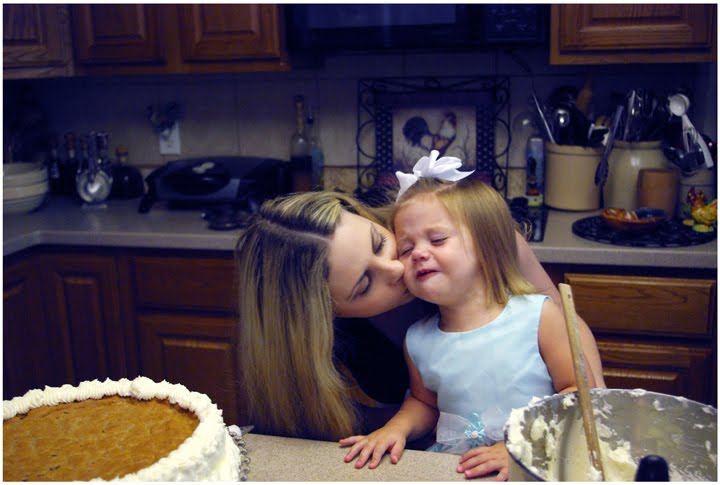
Bronwyn, 2000 Patterson Cypress Sawmill Festival Queen caringly comforts her daughter. You don't know what has upset her young daughter but you do wonder if this is only one of many times mom will use her pageantry experience to console the hurt feelings of her daughter if she too becomes a contestant and possible future queen?

Nissa, 1991 Job's Daughters Miss Congeniality. This photograph and the other one in the show of Nissa makes me laugh. In this photograph Nissa appears to be anything but congenial. Is she bored with her current life? Was winning Miss Congeniality the highlight of her life so far?

These photographs and many more of the twenty six images in this exhibit invite you into the world and a little bit the minds of these former queens. Jessie has done a marvelous job capturing the strength of these women. You can see this exhibit through July 30, Monday through Friday 8:30am – 4:30pm at the Steenbock Gallery in Madison, Wisconsin.

original post from Milwaukee photographer William Zuback's blog, June 29 2010


Wednesday, June 16, 2010

HOW CAN MADISON BECOME A STRONGER CENTER FOR INNOVATION?


That's the question being explored in the City of Madison's first cultural planning process. Explore the Madison Cultural plan website to learn what the plan is all about, which creative efforts are included in the idea of culture at the heart of the plan, when and where planning activities will take place, why the the plan is important to Madison's residents, businesses and visitors, and how any resident can get involved.

WHAT IS A CULTURAL ARTS PLAN?

A cultural plan is a community decision-making process that seeks ways to better support and utilize creative work. Cultural plans explore resident’s preferences, the adequacy of public and private structures that support creativity and innovation, and identify specific action steps that can make the community’s creative portfolio stronger, more accessible, more sustainable and more diverse.
WHOSE CREATIVE WORK IS INCLUDED IN MADISON’S CULTURAL PLAN?
The Madison Cultural Plan will explore the arts, history, and the sciences and will include exploration of the work of individual artists and creative workers as well as institutions in both the commercial and nonprofit sectors. The plan intentionally defines culture broadly. It includes, for example, individuals and organizations who are students, amateurs, and professionals working in such varied fields as artisan food production; digital production; architecture; history and heritage; traditional, experimental; and fine arts; scientific research; software and hardware development; advertising; publishing; gardening; entertainment, environmental programming; and so forth. If creative content drives the work an individual or organization does, it is included in this plan.
WHY IS THE CULTURAL PLAN IMPORTANT TO MADISON?
Creativity and innovation have long been major drivers of Madison’s unique character and its economic base. They are woven into our sense of place. Just as it is important to plan the ways in which the city supports neighborhoods, it is important to plan the ways in which it’s policies and resources support creativity and innovation.
  • What is Madison’s vision for its arts and cultural future?
  • What arts and cultural opportunities do residents want for themselves and for their children?
  • How can broad access to opportunities in creative play, learning, and work be promoted?
  • Are we making the best use of our public and private facilities?
  • What structures and resources are necessary to strengthen and sustain our creative community?

The planning process will include research; GIS mapping; surveying; conducting interviews, focus groups, roundtables, and public hearings; and working with a local Steering Committee in the formulation of recommendations for action.

GETTING INVOLVED
Learn more about how you can get involved. Your voice is important. There are opportunities to complete surveys, participate in public meetings, and even conduct your own discussion groups with peers, friends, or co-workers. The strength of the plan relies on the willingness of residents, artists and creative workers, and creative institutions, commercial and nonprofit, to participate. Check the Get Involved page; it’s fun!

WHO IS CONDUCTING THE CULTURAL PLANNING PROCESS?

The City of Madison has retained Mary Berryman Agard & Associates and partners Vandewalle &  Associates, and Robert Bush to conduct the cultural plan.
 The City of Madison staff person leading this effort is
 Karin Wolf, Arts Program Administrator
Madison Arts Commission
Department of Planning, Community & Economic Development
Madison Municipal Building
215 Martin Luther King Jr. Blvd.
Madison WI 53701-2985
608.261.9134
KWolf@cityofmadison.com

Thursday, May 27, 2010

Interview with photographer Ellen Pizer, DRIVEN TO ABSTRACTION

Our new exhibit features fascinating, playful, colorful and surprising abstract photographs by Milwaukee photographer Ellen Pizer, who, as it turns out, is as surprised as the rest of us, but will let you in on the secret if you ask nicely...


1.  The work in this exhibit just runs away with peoples' imaginations, and there's great and constant conversation about of what the image is, of what it reminds someone, and how it makes the viewer feel. Conversely, I saw a lot of different people throw their hands up at you and say "what IS it?"  With such emotional images, that are so personal to each person who views them, how do you feel when people ask you for the answer - do you like to let them in on the secret of the abstraction, or do you worry it may change how they interact with the piece?

The first time I exhibited my abstract photographs I was actually surprised that people were so curious about them.  If I’m asked, I have no problem telling people what they’re looking at, although there have been a few times where I’ve had to go back to try to figure it out for myself.   I’ve learned to take at least one wide angle shot of the area before I leave to give myself some point of reference.

I guess there are different ways of viewing my photos.  First is the immediate impact; the design, colors or whatever causes a viewer to stop and take a look.  But I think there is something within us that needs to know what we are looking at.  When it’s a painting, we feel free to see what we want whether or not it’s what the artist was trying to convey.  But when we know it’s a photograph, I think we want to understand what it is or where it was taken. We need to place the image in some context of its surroundings.
 
I actually enjoy listening to people try to figure out what they're looking at, and I think they have fun with this process as well.  Years ago I actually had a contest offering an 11"x14" print to anyone who could correctly figure out what "Looks Like Something Growing" was a picture of.  No answer even came close.

I usually do not worry about people changing the way they interact with my work.  I just want them to enjoy it.  It doesn't matter if they like it upside down or sideways.  The fact that they're curious enough about it to ask is quite a complement in itself.  I hope my work reflects the fun I’m having.  Sharing my photos with others feels kind of like a little kid excitedly saying, “Look what I found!” 

The only time I have ever hesitated about revealing a photo’s origin was when the shape on a maroon dumpster consisted of bird poop.  I'm not sure that information would have had a positive impact - although the shape was actually very sensual and the piece was titled "Come on Over and See Me Sometime."

  2. You have work in this exhibit that is printed and framed in a straightforward manner, as well as some pieces printed on canvas and stretched, and others printed on satin and hung.  Would you talk about the different substrates you're working on, and about how you pair imagery with surface?

I started printing on canvas several years ago at the request of a gallery owner who is also a painter.  She felt that some of my photos inspired some of her paintings and wanted to see what my work would look like printed on canvas for a show at her gallery.  I have over time learned that there are some images that lend themselves more to canvas than others – usually it is the more abstract and heavily textured images that I think can be enhanced by the texture of the canvas.  I am not a painter, however, and try not to pretend that I am.

Trying out satin began when an artist wanted to know if we could print on material that he could use to refurbish an old decorative screen he had found.  He still hasn’t finished creating his image for that screen, but since the satin was lying around I thought I’d try it out.  Because one side of the satin is coated so that the inks will adhere to the material, the shiny side is actually the back. At first I was disappointed because it wasn’t what I had anticipated. 

I printed one image on matte paper, semi-matte paper and satin.  I laid them next to each other on a table.  At first glance the satin print appeared more muted than the other two.  I left the images there for several weeks and for some reason the satin image kept drawing me back.  I finally realized that the image printed on satin was more “fluid”.  That’s the only word I can use to describe it – it has movement and when light shines through it from behind, it actually glows.  I therefore look for an image that is simple and can be enhanced by movement or something where colors blend into each other without hard edges or textures.  

3. I heard, through the chattering crowd, something great at the opening.  You were talking to a guest and you said that when you're out exploring to make these images, you approach that "hunt" with more intensity than you do anything else in your life.  Would you elaborate on your process for shooting this work, and maybe even talk about how that's different from the rest of your life?

I tend to be pretty intense about everything in my life.  When I first started back into photography my mother was in her nineties and both of my sons were teenagers.  I had a lot on my mind to say the least.  But when I was out with my camera, even for just a short time, I noticed that my mind was so completely absorbed in the “treasure hunt” that I didn’t think about anything else.  I did not worry, I didn’t think about what time I had to be somewhere, or whether my kids had finished their homework.  I did not think about anything else except what existed within the viewfinder of my camera.  It brought me such peace, a reprieve from the stresses of everyday life. 

Sometimes it takes me awhile to get into that zone, to find something that excites me.  Usually I will force myself to keep looking, to keep walking, to turn around until something catches my eye.  When I find a colorful rusted dumpster or a graffiti covered railroad car, I feel like a kid at an amusement park.  There is an excitement that is hard to describe.  What is funny is that I may have passed that site many times without ever paying attention, but at that moment I am seeing it as if for the first time. 

4.  Stylistically, you've got some amazing different abstractions going on.  A piece like "Towering Facade" has a very crisp and geometric feel of color blocks, line and shape and calls to mind the work of
Mondrian, while a piece like "Hearts and Flowers" has an extremely Pollock-y expressive feel to it.  These styles can be considered to be fairly diametric, so what is it about each of these styles that calls to you so strongly?

I think it’s the magic of the viewfinder.  A building is a building is a building; some beautiful, others not; some unique, others commonplace. But the viewfinder forces me to look at the parts of the whole.  Shapes appear, shadows define, angles are enhanced and I just begin shooting, getting closer, backing up, moving around.  Each piece becomes a whole.  Some juxtaposition of shadows and light, color or textures, just begins to jump out at me.  I really don’t think about composition.  It just feels right or it doesn’t, although it often takes time and a number of shots until I get there. Although I kind of went kicking and screaming into the digital age, I’m thankful that I can shoot as much as I want without thinking about the cost of film or processing.

When it comes to the more painterly abstractions, it once again begins with the power of the viewfinder.  When I find a colorful dumpster with lots of spills and splatters and scrapes it feels as though I am entering a fine art gallery but without any definitive framed pieces.  It’s all just a haphazard jumble of color and texture.  But when I put the camera up to my eye, the viewfinder begins to frame the chaos.  And as I move around and close in or move back, any number of possible images begin to appear. 

In a way both the graphic and the painterly images are discovered through a similar process…closing out the visual chaos and zeroing in on what I find are the essential elements.

5. Are you ever surprised at how the image comes together or when you shoot it do you know how one image will stretch on canvas and look like a painting, while another will flutter in the breeze on satin and look like a tapestry?   Are you ever surprised by your own work?

I am sometimes disappointed to find that what I found so exciting while I was out shooting, just doesn’t translate into a photograph, but I would not trade the experience of finding that image for anything.  Even when an outing yields nothing worth printing, the experience itself is rewarding.  I’ll often see little pieces in what I’ve photographed that look interesting and go back to the site to get a different view.  Then there are the times when I didn’t think I got anything good and there amongst the boring will be an unexpected gem or two.

I don't really think of how an image may be printed when I'm out shooting.  Actually I don't "think" at all when I'm shooting.  I don't really previsualize very well so printing is often just experimentation. Sometimes I’ll proof on canvas, satin and several papers and then look at them over a period of time before deciding which I like best.

What has been most surprising even to me, is how small an area I’ve actually photographed.   Because I get so lost in the viewfinder I often have no idea how close I am or what a small piece of the whole I am looking at.  The image “Beauty Comes with Age” is a perfect example of that.  The first print I made for a show was 40"x60". It was sitting in my studio waiting for the gallery to pick it up.  A friend asked what it was and I took him out to the metal dumpster behind the studio and pointed to an area on this huge dumpster which was maybe 6" in diameter.  I was as shocked as anyone.